Setting up Hermes Agent on an old Mac
July 23, 2026
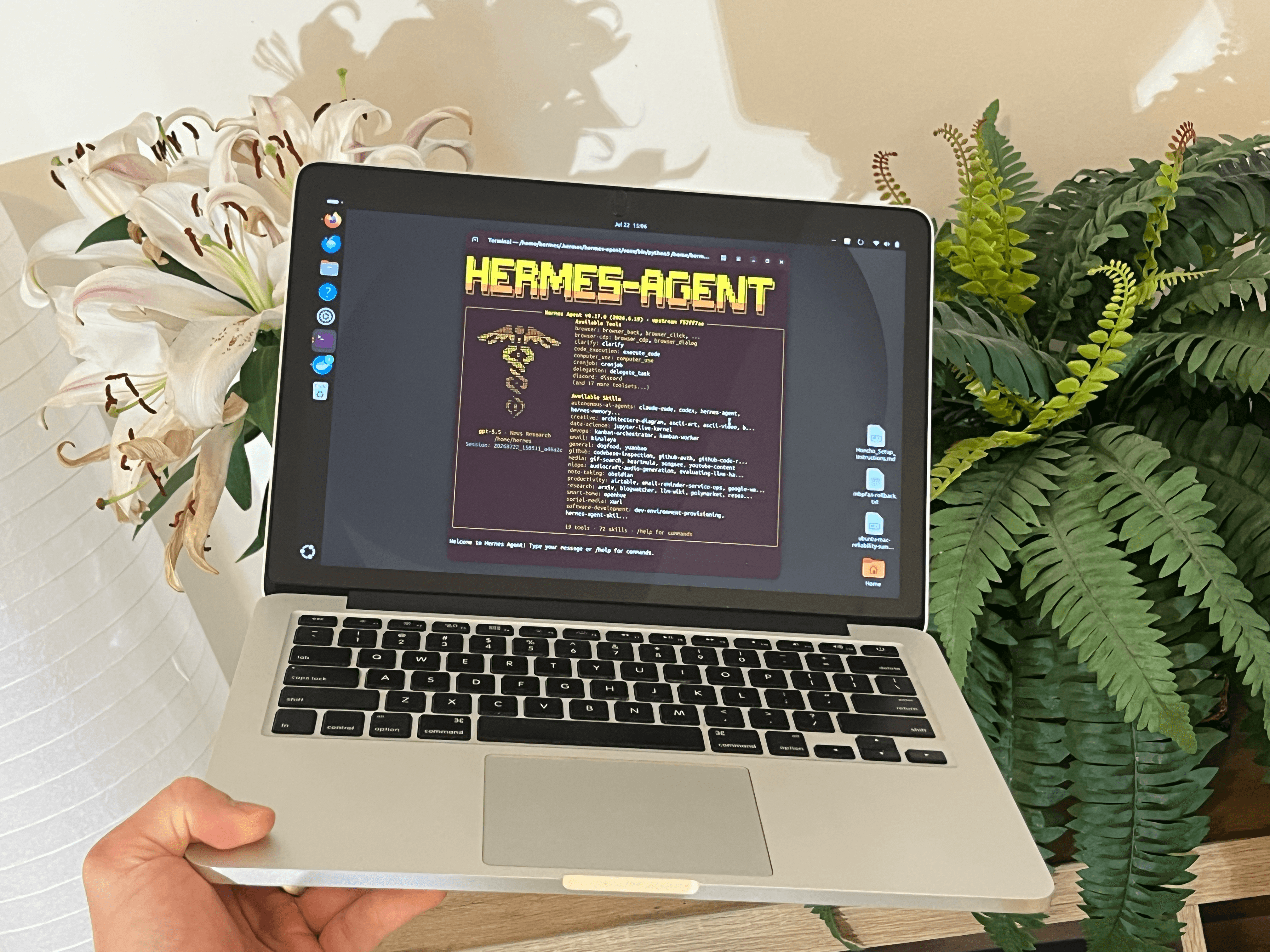
I recently set up a Hermes Agent because I wanted to see what the hype was all about with personal AI agents. In a rare case where keeping old electronics worked out in my favor, I used my old college-era MacBook Pro. I must have been doing something weird with it when I last used it because there was no OS installed on the machine. For some reason, booting the Mac in recovery mode only allowed me to download macOS Mavericks, the OS the machine shipped with when it was made in 2014. From there, there was no option to update to a newer OS, despite the fact that the machine ran on Catalina when I abandoned it. I ended up downloading Ubuntu onto a USB stick from another device and installing the OS from the stick.
It took a bit more finagling to get the machine usable. The Linux keyboard shortcuts felt unnatural to me, so I found Toshy, a package that maps macOS keyboard shortcuts onto Linux. That made zooming around between terminal tabs a lot easier. The MacBook also had some weird network and heat issues at first while running Linux. Wi-Fi speeds were incredibly slow, so I had to install a new Wi-Fi driver, and I used Codex to write and test some custom fan logic so the fans would ramp up sooner in response to heavy CPU loads to keep the machine from overheating.
To get Hermes on equal footing with my other machines, I had it clone my cloud dev env repo and run all the same setup steps that project does when provisioning a new VPS. That gave the Hermes machine all the basic tooling I have everywhere else without me having to configure anything by hand.
So far I haven't used Hermes for much, but I did set it up with the LLM-memory system Honcho (by Plastic Labs), and it was cool to just message Hermes on Telegram and tell it to figure out how to set up Honcho. I've also been helping a friend set up a personal website, and when they sent me an email with some updated copy, I had a pretty cool moment just forwarding the email to Hermes and telling it to update the site accordingly.