The archaic nature of intellect
March 30, 2026
There are many behaviors that signal the intelligence of an animal, but the behaviors are just that — signals. They're not the underlying intelligence itself. The capacity for these intelligent behaviors is one's intellect, like a child's ability to learn calculus despite not yet having learned algebra. High-level human intellect is considerably older than the evidence typically cited for it, not because that evidence is wrong, but because it only tells us when a behavior first appears in the archeological record, not when the capacity for it first evolved.
First, two important concepts to keep in mind:
-
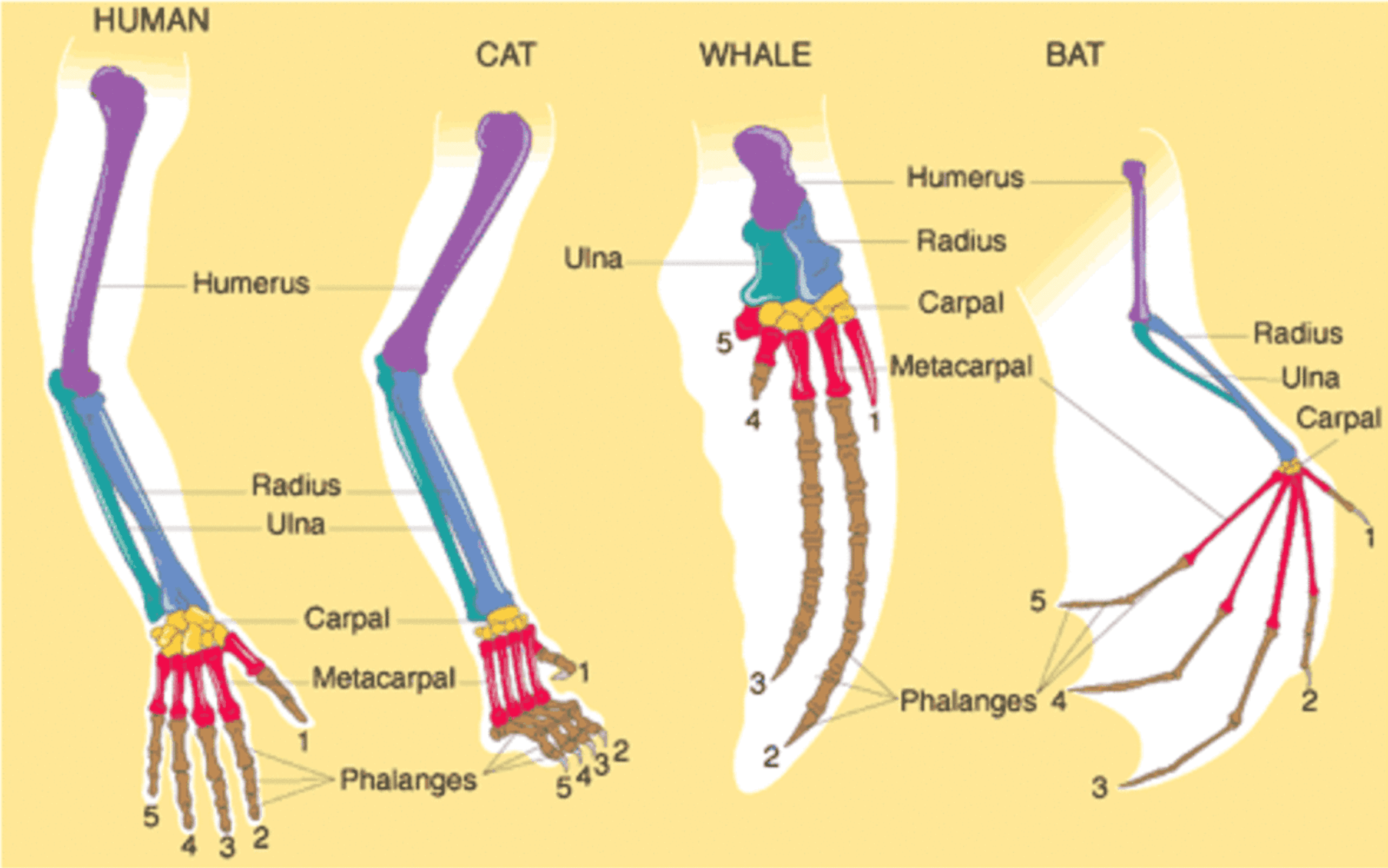
Shared inheritance refers to traits and behaviors that appear in two or more species and that were passed down from their common ancestor. An evolutionary biologist might refer to this as synapomorphy or homology, but I think "shared inheritance" is more intuitive and approachable. The textbook example of shared inheritance is the anatomical similarity in the forelimbs of mammals (see Figure 1).
-
Convergent evolution is the process by which similar traits and behaviors appear in two or more species, arising from independent adaptations to similar environmental pressures.
For example, both bats and dolphins use echolocation to navigate and hunt, but they developed this ability independently. Dolphin echolocation is specialized for use underwater and bat echolocation for air, and as a result there are large anatomical differences between the two systems that suggest they aren't a form of shared inheritance. But there's a simple heuristic for arriving at this conclusion without getting into the weeds of anatomy. The common ancestor of bats and dolphins is thought to have lived at least 60 million years ago, and if bats and dolphins inherited echolocation from a common ancestor, then we would reasonably expect to see echolocation in at least some of the other animals that share their common ancestor, such as dogs, cats, horses, and cows (see Figure 2). Said another way, it would be surprising if the common ancestor of bats and dolphins had echolocation but the overwhelming majority of its descendants lost the ability[1].

This heuristic also works the other way around. The presence of a given trait or behavior in closely related species indicates that it likely arose in their common ancestor, rather than as a product of convergent evolution. This heuristic is especially useful for thinking about shared behaviors, since they often don't rely on underlying anatomy specialized for the task. Consider the following three examples.
1. Counting
Counting is the ability to determine how many elements exist in a finite set of things. A more technical term for this ability is numerosity, which implies an organism has a numeric sense, but doesn't necessarily "count" one by one as a child might, using their fingers or voice. The earliest evidence in the archeological record for the human ability to count is the 40-thousand-year-old Lebombo Bone, pictured below. It's thought to be a calendar, used to track the passage of days in a lunar cycle. While humans may be the only animals that have a numeric sense for very large numbers, we are not the only animals that can count. Bees, for example, can both count and communicate numeric values. Honeybees, in particular, use what's called the waggle dance, a flying movement that communicates the direction and distance to an item of interest they've identified, which could be a food source, water, or a potential site for a new hive. In lab experiments, honeybees can also distinguish two sets with a different number of objects and can do basic addition and subtraction.

The common ancestor of bees and humans probably lived over half a billion years ago, and millions of extant species share the same common ancestor, so it's very unlikely that we inherited the ability to count from our common ancestor with bees. If we did, we would expect to find counting animals everywhere. But, consider our closest living relative — chimpanzees. They can also count. Therefore, it's likely that the human ability to count is at least as old as our common ancestor with chimpanzees, which is thought to have lived around 7 million years ago. As many other apes and monkeys can also count, the human capacity for counting could in reality be tens of millions of years old. So, while the Lebombo Bone is interesting for a number of reasons, its suggestion that humans had the ability to count 40 thousand years ago is not groundbreaking.
2. Tool-use
Broadly speaking, a tool is an external object that an organism uses to achieve a goal that it could not achieve as easily with its body alone. Tool-use exists in a wide variety of animals but is rare relative to the number of known species. The types of tools used also vary widely from species to species, so it's safe to assume that tool-use in distantly related species is a form of convergent evolution.


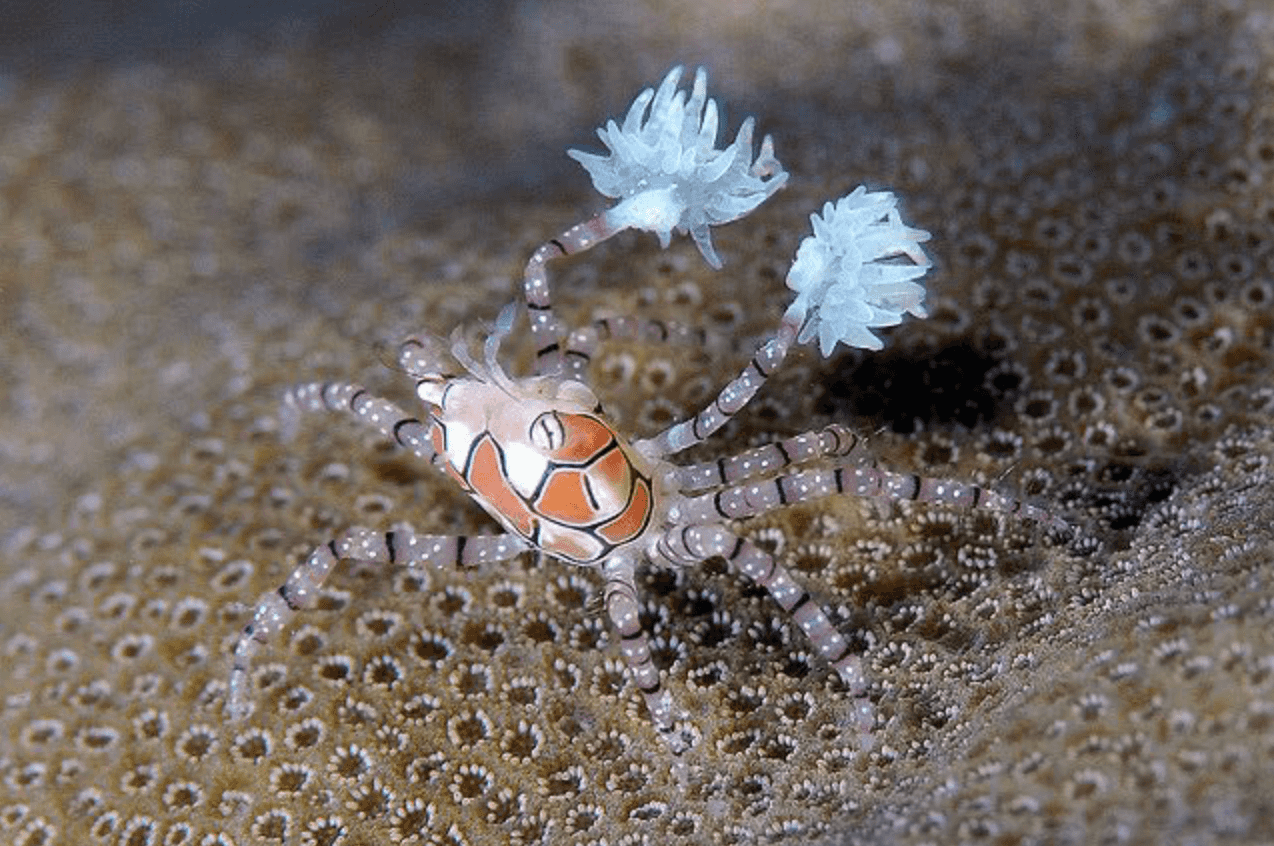
As I mentioned in Half a million years of Homo sapiens, the oldest evidence of stone tool-use is 3.3 million years old, associated with the extinct genus Australopithecus, thought to be the precursor to the genus Homo. Chimpanzees and a variety of other primates also use stone tools though, so it's probably a much older behavior. But some of the Australopithecus tools were deliberately altered, specifically to produce sharp edges. There's no definitive evidence of primates intentionally altering stone tools in the wild, but they clearly do so in captivity. Capuchins, bonobos, and orangutans all do so. While in each case these animals only displayed this behavior after being taught by humans, it's nevertheless undeniable that they have the capacity for creating stone tools. This suggests that the capacity for manufacturing stone tools is much older than the oldest direct evidence for it. And while the evidence for stone tool-use is about seven times as old as the oldest evidence of wooden tool-use, the 476-thousand-year-old Kalambo structure, there is much stronger evidence that the ability to manufacture wooden tools is the shared inheritance of all great apes, and perhaps of all primates. Most live in environments where wood is much more plentiful than stone, and many deliberately alter twigs, branches, and other wooden materials for use as foraging and hunting tools. In particular, some chimpanzees deliberately chew the ends of branches to make them sharp, then use them as spears to hunt bushbabies nesting in tree hollows.
So, imagine you just discovered a 5-million-year-old wooden archeological remain. As I discussed in Ancient history's blind spot, it would be very surprising to find a wooden remain that old. But, if you did, despite being ten times as old as the Kalambo structure, it wouldn't be incredibly surprising if it was an intentionally crafted wooden tool like a spear.
3. Boats
Boats are just a sophisticated tool, a floating device used to navigate a body of water[3]. Some animals understand how to manipulate buoyant objects, but humans are the only known living animals that build boats. The oldest known boat is the Pesse Canoe, discovered in the Netherlands in 1955 and dated to about 10 thousand years old, and the oldest known seafaring boats are the La Marmotta Canoes, discovered in Italy and dated to around 7 thousand years old. But there is strong evidence that Homo sapiens were a seafaring species much earlier and that even some long-extinct hominin species were as well.
The oldest evidence of human presence in Australia dates to 65 thousand years ago, and, even during periods of low sea level, there has always been open sea separating the Australian continental shelf from that of Southeast Asia. The region that separates the two continental shelves, known as Wallacea, has a number of deep-water straits that generate powerful and unpredictable currents, making the region difficult to navigate even for modern ships. It also straddles the equator, which means that even in the coldest glacial periods there was no sea ice present for animals to accidentally drift across the sea on. This is the reason for Australia's unique plant and animal life, and it also suggests that some groups of Homo sapiens were capable of navigating the sea at least 65 thousand years ago.
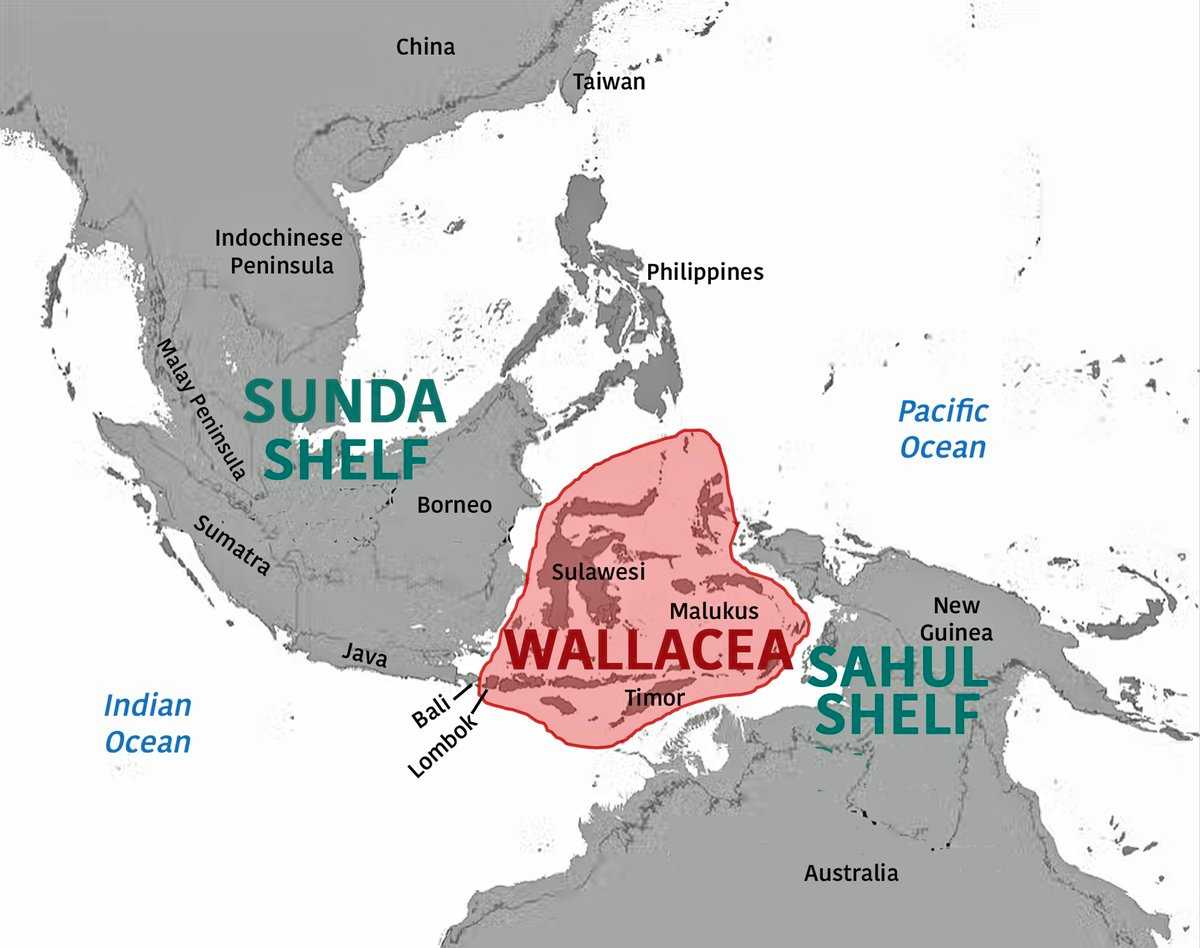
The presence of Neanderthal remains on a number of Greek islands, in particular 130-thousand-year-old stone artifacts on the island of Crete, indicates that Neanderthals were a seafaring species, too. Neanderthals, by the way, are the closest known relatives of Homo sapiens that have ever existed. There are also significantly older hominin artifacts on islands in Wallacea, dating from 1 million to 1.5 million years old, thought to be the remains of Homo erectus. Although no one has ever successfully sequenced the DNA of Homo erectus, they are believed to be the common ancestor of Homo sapiens and Neanderthals. This suggests that the capacity for boat-building in Homo sapiens and Neanderthals is a form of shared inheritance, predating the La Marmotta canoes by at least a million years.
A thought experiment
Imagine that an extraterrestrial species arrives on earth with the intention of teaching a group of humans advanced concepts in physics. While we might suspect that this species has a more powerful intellect than humans, there is no way to know for sure based on this information alone. It only suggests that they possess knowledge that humanity doesn't. Assuming humans can successfully learn their physics, then by definition we have the capacity for it. This is a crucial point to emphasize. The above example about boats doesn't suggest that archaic humans were building aircraft carriers or Spanish galleons to cross oceans, and it would probably be unreasonable to assume that most of them ever built even the most primitive form of boat. Most people alive today have no reason to build a boat or to navigate the sea, and most humans throughout history probably didn't either. The knowledge of boat-building and seafaring is not an inherited human trait, but the capacity for these activities is.
This is especially important to keep in mind when considering the rapid advance in human knowledge and activity since the beginning of the agricultural revolution, about 10 thousand years ago. Just as our capacity for counting, making tools, and building boats is much older than commonly assumed, we likely possessed the intellect required for agriculture long before it was first implemented at scale. Everything since then — writing, the renaissance, and the industrial revolution — has unfolded so quickly, relative to the long history of human evolution, that little, if any, cognitive evolution has occurred simultaneously. Therefore, our unique period of history is one marked by rapidly increasing knowledge, not intellect. This makes the question of why agriculture happened when it did even more intriguing, and I intend to write about that in a future post.
Notes:
-
Apparently humans can develop the ability to echolocate, so there could potentially be a more general mammalian ability to echolocate, but there is clearly not a general reliance on it. The vast majority of mammals do not have specialized organs for echolocation like bats and dolphins do.
-
I discovered while writing this post that there is archeological evidence of tool-wielding capuchins from 3 thousand years ago. This is pretty cool but also extremely unsurprising, considering how small 3 thousand years is in comparison to tens of millions of years of primate evolution.
-
Technically, an archeologist would consider a raft a primitive form of watercraft that's distinct from a boat. I'm considering a raft a primitive form of boat.